An architectural delight in Prague
Architecture is inextricably woven with travel. Apart from landscapes and natural vistas, majority of iconic landmarks and tourist attractions are buildings. Buildings are inherent in cityscapes and urban landscapes. Moreover, cityscapes are draw cards for travellers in their itinerary for adventure - whether its churches, bridges, museums, hotels or even some retail therapy.
Prague, like most cities in Europe, is a city of visual delight. In preparation for the trip, I have browsed through numerous travel and photography monographs on the city's architecture that seeing firsthand Prague's landmarks was awe-inspiring. As an architect and a bibliophile, akin to reading and turning the actual pages of an interesting book, seeing these enthralling edifices is a tactile experience.
Art Nouveau, also known as Style Moderne or Jugendstil is an architectural style which flourished in major European cities between 1890 and 1914. My interest in this movement was through studying the works of American architects Louis Sullivan and Frank Lloyd Wright and Scottish architect Charles Rennie Mackintosh. In Prague, the movement was led by Czech painter and decorative artist Alphonse Mucha (1860-1939).
It was surprising to me that there are quite a large number of remarkable and well-preserved buildings in Art Nouveau style in Prague. I learned that as there haven't been any destruction/reconstruction programs in Prague as in much of western Europe, nearly all the original Art Nouveau buildings have remained. However, these buildings remain unknown to tourists as they mostly pay attention to the popular Prague Castle and Charles Bridge. But if you know what to look out for, the Old Town, the Jewish Quarter and Wenceslas Square are dotted with Art Nouveau style buildings. Looking up these buildings will treat oneself to beautiful architectural details and decorations. Perhaps the most well-known building is the Municipal House at Namesti republiky 5.
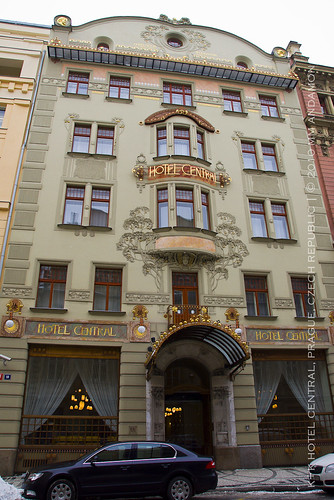
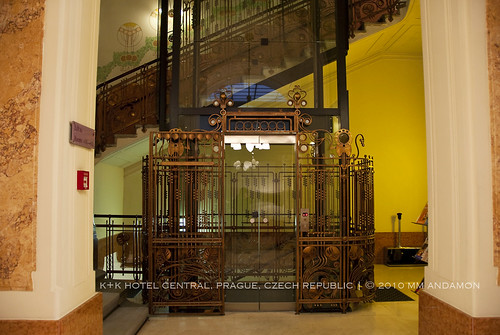
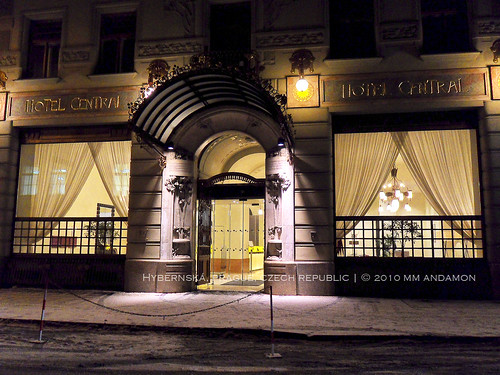
I stayed in one of the first Art Nouveau buildings in Prague which is just a few metres from the Municipal House and the Powder Tower. The former Hotel Central built 1898-1900 is now the K+K Hotel Central at Hybernská. This 4*-boutique hotel in the city centre of Praque is located within a short walking distance from the Main Train Station (Hlavní nádraží) and Old Town Square. Designed by Bedřich Ohmann (1858-1927) and his students Bedřich Bendelmayer (1872-1932) and Alois Dryák, unique Jugendstil architectural details adorn this very stylish hotel.
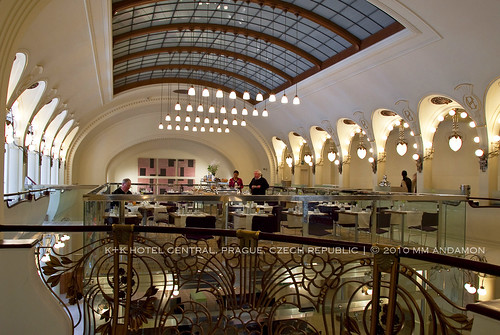

Apart from its proximity to the sights of the Old Town Square, this architectural gem will certainly delight the architectural traveller.
Prague, like most cities in Europe, is a city of visual delight. In preparation for the trip, I have browsed through numerous travel and photography monographs on the city's architecture that seeing firsthand Prague's landmarks was awe-inspiring. As an architect and a bibliophile, akin to reading and turning the actual pages of an interesting book, seeing these enthralling edifices is a tactile experience.
Art Nouveau, also known as Style Moderne or Jugendstil is an architectural style which flourished in major European cities between 1890 and 1914. My interest in this movement was through studying the works of American architects Louis Sullivan and Frank Lloyd Wright and Scottish architect Charles Rennie Mackintosh. In Prague, the movement was led by Czech painter and decorative artist Alphonse Mucha (1860-1939).
It was surprising to me that there are quite a large number of remarkable and well-preserved buildings in Art Nouveau style in Prague. I learned that as there haven't been any destruction/reconstruction programs in Prague as in much of western Europe, nearly all the original Art Nouveau buildings have remained. However, these buildings remain unknown to tourists as they mostly pay attention to the popular Prague Castle and Charles Bridge. But if you know what to look out for, the Old Town, the Jewish Quarter and Wenceslas Square are dotted with Art Nouveau style buildings. Looking up these buildings will treat oneself to beautiful architectural details and decorations. Perhaps the most well-known building is the Municipal House at Namesti republiky 5.
I stayed in one of the first Art Nouveau buildings in Prague which is just a few metres from the Municipal House and the Powder Tower. The former Hotel Central built 1898-1900 is now the K+K Hotel Central at Hybernská. This 4*-boutique hotel in the city centre of Praque is located within a short walking distance from the Main Train Station (Hlavní nádraží) and Old Town Square. Designed by Bedřich Ohmann (1858-1927) and his students Bedřich Bendelmayer (1872-1932) and Alois Dryák, unique Jugendstil architectural details adorn this very stylish hotel.
Although the well appointed hotel displays a contemporary interior design with modern amenities, the Art Nouveau details have been preserved particularly on its front facade, the delicate details of metal railings, ornate light fixtures, curved mouldings of the breakfast restaurant which used to be a theatre hall c 1900 and the glass elevator.
Apart from its proximity to the sights of the Old Town Square, this architectural gem will certainly delight the architectural traveller.
Labels: Adventures, Architecture, Design, Digressions, Photography, Travels
posted by Unknown at 10:21 pm
0 comments