Wednesday, January 09, 2013

The Colour Purple is Hot

The daytime temperature today in Melbourne hovered at a nice and cool low 20s - max at 21.0°C (69.8°F). It's unbelievable that the temperatures late week, particularly on Friday topped almost 41.0°C (105.8°F).
The sweltering heat with record breaking maximum temperatures was felt across Australia - it was 44°C (111.2°F) in Adelaide on the same day!

In the last few days, Australian temperature maximums have ranged from 40°C to 48°C setting a new national average maximum of 40.33°C (104.59°F) on 7 January 2013. This prompted the Australian Bureau of Meteorology to extend the temperature range of its weather forecasting charts to 54°C (previously capped at 50°C) and adding new colours - deep purple (for 50-52°C) and magenta (for 52-54°C). Burnt orange and black depict temperatures ranging from 40-48°C.
Forecast Chart for 6-7 January 2013, Source: Australia Bureau of Meteorology (BOM)

The combination of hot temperatures, very dry conditions (got to 4%RH in Adelaide!) and gusty winds was just the recipe for horrendous bushfires, some of which are still raging in the four south eastern states - Tasmania, New South Wales, Victoria and South Australia.

The bureau reported that the first six days of 2013 were all among the hottest 20 days on record in terms of average maximums:

1 January 7, 2013: 40.33 degrees
2 December 21, 1972: 40.17
3 December 20, 1972: 40.01
4 December 22, 1972: 39.82
5 January 1, 1973: 39.79
6 January 6, 2013: 39.71
7 December 17, 2002: 39.7
8 January 2, 1973: 39.65
9 January 3, 2013: 39.55
10 December 16, 2002: 39.54
11 December 30, 1972: 39.48
12 December 31, 1972: 39.43
13 January 27, 1936: 39.4
14 January 1, 1990: 39.39
15 January 4, 2013: 39.32
16 January 5, 2013: 39.26
17 January 2, 1990: 39.22
18 January 2, 2013: 39.21
19 December 18, 2002: 39.2
20 January 13, 1985: 38.98

Australia's climate in 2012 was extreme to say the least - cooler and wetter the first half of the year and warmer and drier than average on the second half. BOM reported that the maximum temperatures in 2012 were 0.51°C above average, and minimum temperatures of 0.28°C below average, making the year a warmer-than-average year, 0.11°C above average.

It's ominous that the bureau's forecasting models are showing temperatures in excess
of 50°C (122°F) for 2013.

Labels: , , , ,

Wednesday, January 26, 2011

Tour Down Under

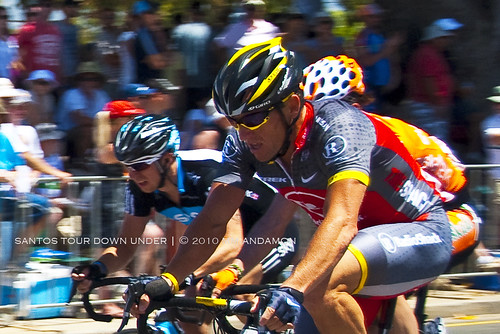
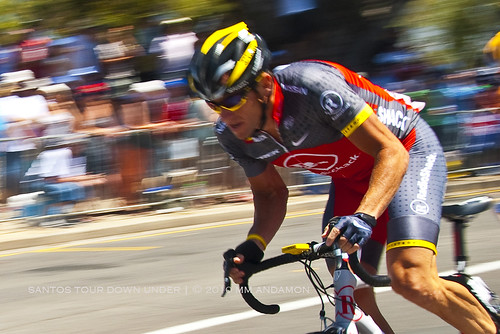
Having missed this year's 2011 Tour Down Under in Adelaide, I wasn't able to complete my photo-chronicle of Lance Armstrong's participation in the cycling race. Armstrong's attendance in the tour has come to an end with this year as his last.

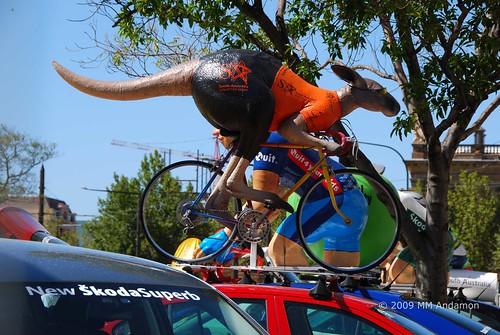
Not that I know anything about professional cycling but in 2009, I was one of those who braved the sweltering Adelaide summer for some photo opportunities. In 2010, I once again took to my favourite spot on Montefiore Hill in North Adelaide to replicate those 2009 race images.

These images of Lance Armstrong were from last year's Santos Tour Down Under:

Lance Armstrong

...swoosh...

Labels: , , , , , ,

Sunday, January 03, 2010

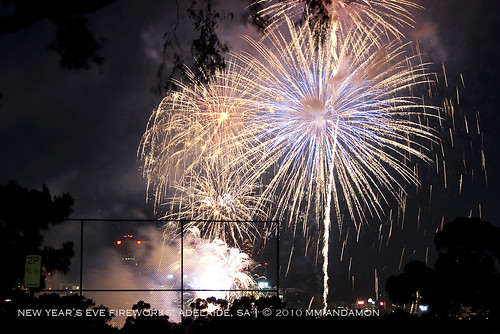
Happy new and bountiful 2010!

Saturday, April 04, 2009

...then at sundown

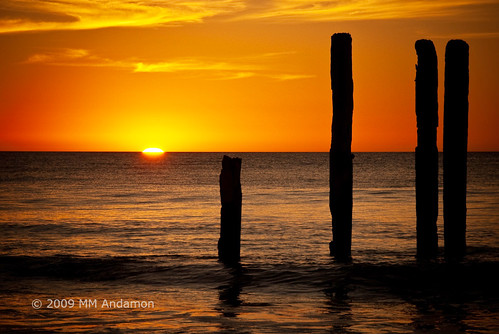
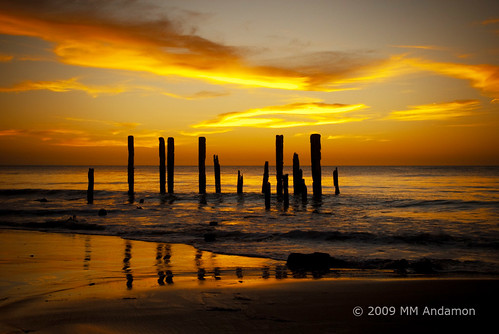
After doing the sunrise shots, I had the opportunity of capturing some amazing sunset images. South Australia's coast along the western shore of Fleurieu Peninsula affords perhaps one of the best sunsets in the world. The jetties that dot the shoreline of Gulf Saint Vincent offers dramatic vistas with the setting sun as backdrop.

Taking a little road trip with two photobuddies, our destination was the coastal town of Willunga, about 50 kms south of Adelaide CBD. This town has one of the iconic locations for amazing sunsets - the remains of the old Port Willunga jetty, c 1910.

With daylight savings time still in effect, sunsets would be late than usual giving us ample time to leave work, beat the heavy Friday traffic and be at the location for the shoot. We knew (and hoped) that the sunset would be perfect.

Fortitude

The panoramic view of the few remaining piles of the old Port Willunga jetty did not disappoint. From the top of the cliff, a breathtaking view of the sunset greeted us.

Old Jetty, Port Willunga, South Australia

The Port Willunga jetty, c 1868-1913
The few remaining piles are what is left of the jetty constructed in 1867 located 400 metres south of the original jetty built in 1853.

Out on a Friday night chasing light? - truly well worth it.

Labels: , , , , , , , ,

Sunday, March 22, 2009

At first light

Dragging myself out of bed before sunup especially on a weekend is such a feat. With the start to autumn and the now chilly mornings, I would rather sleep in. Who wouldn't? But having longer nights and with end to daylight savings still two weeks away, sunrise in Adelaide would be around 7am (CST). Still pretty much not a big ask to roll out of bed for some early morning photographic adventure.

Inspired by Christina Dickson's entertaining narrative on sunrise photography tips, over the weekend, I found myself setting up on top of Montefiore Hill in North Adelaide well before daybreak for my first sunrise photographs.

Is that rain I just felt?

For awhile there, I thought the seemingly dark clouds on the south-west will usher in a downpour. Not armed with an umbrella to protect the gear, I braced myself being caught in a rather unpleasant predicament. But all's well - though it did rain, it was light and did not last long to entirely ruin my outing.

Then, in Christina's words, "I smile..."

and I smile...

Out early in the morning, loss of sleep - truly well worth it.

Labels: , , , , , ,

Wednesday, January 28, 2009

Sizzling Hot

Adelaide continues to sizzle this week - though not with hot sporting events within and around the city but scorching record 40-plus degree temperatures. The furnace-like temperatures across most of South Australia and Victoria started early this week on Australia Day. In Adelaide, Australia Day temperatures maxed at 36.6°C and soared yesterday to 43°C to be the hottest day in five years in the city.

Today's maximum temperature in the city of 45.7°C was likewise one for the record books. Yet no cool change is in sight with a forecast of a 6-day run of 40deg-temperatures. A similar weather forecast holds for Melbourne, where the gripping final games of the Australian Open are playing out. As the grand slam tournament is typically held in the middle of the Australian summer, the games are noted for its hot days. Thus, it is the only major tournament in the world that has an extreme heat policy. Melbourne's temperature soared to 41°C today which called for the policy to be enacted for the first time.

It was fortunate that last week's Tour Down Under in Adelaide experienced relatively milder temperature conditions which were ideal both for the cyclists and spectators.

2009 Tour Down Under, Adelaide

I shared in the 'Lance Fever' that gripped the city. The record attendance to this year's tour events, up by 35% from last year, was certainly due to the Armstrong factor.

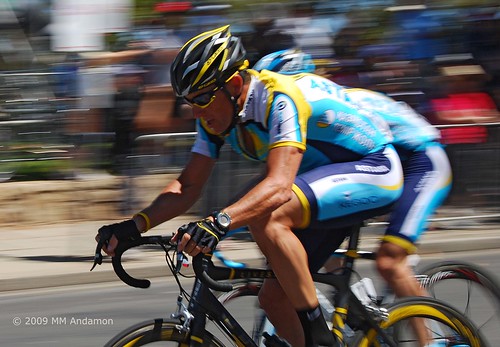
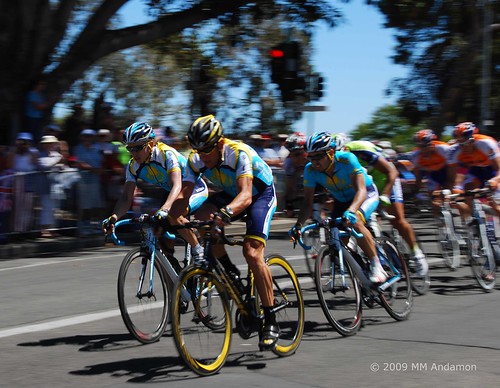
In the final Stage 6 of the race held in the city, I was one of the 144,000 spectators who lined the Adelaide streets despite the sweltering 35°C heat to catch a [g]Lance of perhaps the biggest name in the sport - essentially a brand. Apparently, this record number represented the most for any single sporting event in Australia. Not knowing anything about professional cycling races, I amazed even myself that I patiently stayed for the whole 18 laps of the stage just to be able to take a picture of Lance Armstrong. My patience was wonderfully rewarded at Lap 16 when I eventually captured the images I wanted:

Lance Armstrong

Lance Armstrong and Team Astana

Of course, with full cognition, these images were to be had at a price - painful sunburnt arms! Livestrong!

Karen Cheng did an enlightening interview with Lance Armstrong and sheds light on what motivates this great athlete (as seen in Shai Coggins).

Labels: , , , , , ,

Sunday, January 18, 2009

DownUnder sizzles

Around this time of the year, in the middle of sizzling summer, Australia is abuzz with premier sport tournaments. Starting with the Boxing Day Rolex Sydney to Hobart Yacht Race, the Commonwealth Bank Series: Australia vs South Africa Cricket and of course, the smorgasbord of tennis tournaments - Hopman Cup (Perth), Medibank International (Sydney), AAMI Kooyong Classic (Melbourne), Brisbane International and highlighted by the Australian Open in Melbourne which is the first of the four grand slam tournaments in world tennis.

Which direction?

Adelaide will not miss out on these premier sporting events. Last week saw the first World Tennis Challenge (14-16 January 2009) at the War Memorial Drive. This week, however, is perhaps one of the biggest events - the first pro-cycling race of the year, the 800km Tour Down Under. This year's tour is made much more special because of Lance Armstrong's participation as his comeback race. The cycling tournament kickstart the week-long event today with the 51km Cancer Council Classic Race at Rymill Park right in the heart of the city. Armstrong maintains that he will not win his first race after over three years of hiatus but I'm sure with race fever gripping Adelaide, he will be a sight to see. I hope to watch Stage 6 (Adelaide City Council Circuit) of the race on the final day of the tour - hopefully catch a glimpse of the bike with number 1274 and perhaps photos of the amazing sportsman, his team - Astana and all the other Australian and International riders in action.

Last but not the least and capping this exciting week will be the Cricket Test: Australia vs South Africa on Australia Day, 26 January.

Labels: , , ,

Saturday, July 05, 2008

Adelaide at dusk

Update (06 October 2008): This photo is also featured in the ABC 2009 Weather Calendar - South Australia (December).

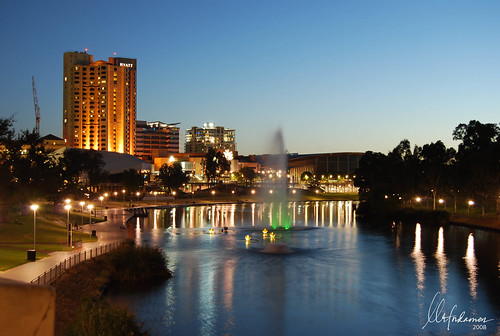
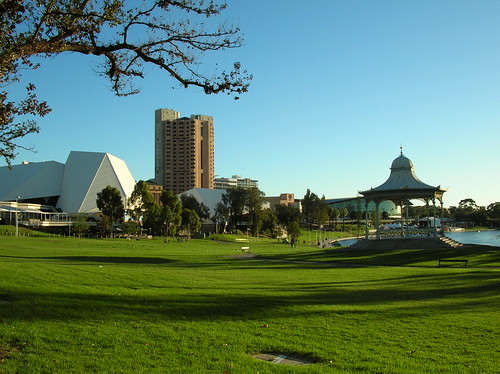
This photo of the Adelaide Riverside Precinct - Torrens Lake taken from the Adelaide City Bridge was the weather photo featured in last Thursday's 7.00pm ABC (Adelaide) news (03 July 2008). This view is frequently featured in postcard photographs of the city that I thought I'd take one myself. This was one of the successful shots in my first attempt at night photography.

Adelaide Skyline at dusk

The photo shows the Riverbank Promenade alongside Elder Park and a segment of the linear river park. This linear park, which is the earliest in Australia, bounds the suburban end of the river and is 35 kms long with playgrounds, walkways and bicycle tracks. On the southbank of the lake, adjacent to Elder Park is the Adelaide Festival Centre. Built in 1973, the cluster of theatres comprising the Festival Centre occupies the area north of the Adelaide Parliament House where the Adelaide Public Baths, 1863-1969 used to be. The baths were built in 1861 and featured Turkish Baths suites, an Olympic size swimming pool (1940 addition) and diving tower. Prominent buildings along the southbank include the Hyatt Regency Hotel and the Adelaide Convention Centre.

The 470 megalitre Torrens Lake was created in 1881 with the construction of a weir, landscaping of Elder Park and modification of the river’s bank and surrounds into an English formal park. The lake forms a centrepiece of many Adelaide events and postcard scenes. At the lake's official opening on 21 July 1881 an estimated 40,000, almost the entire population of Adelaide, attended. Elder Park with its iron rotunda was opened on 28 November 1882.

Elder Park, Adelaide

Labels: , , , ,

Sunday, June 22, 2008

Exploring Adelaide's architectural marvels

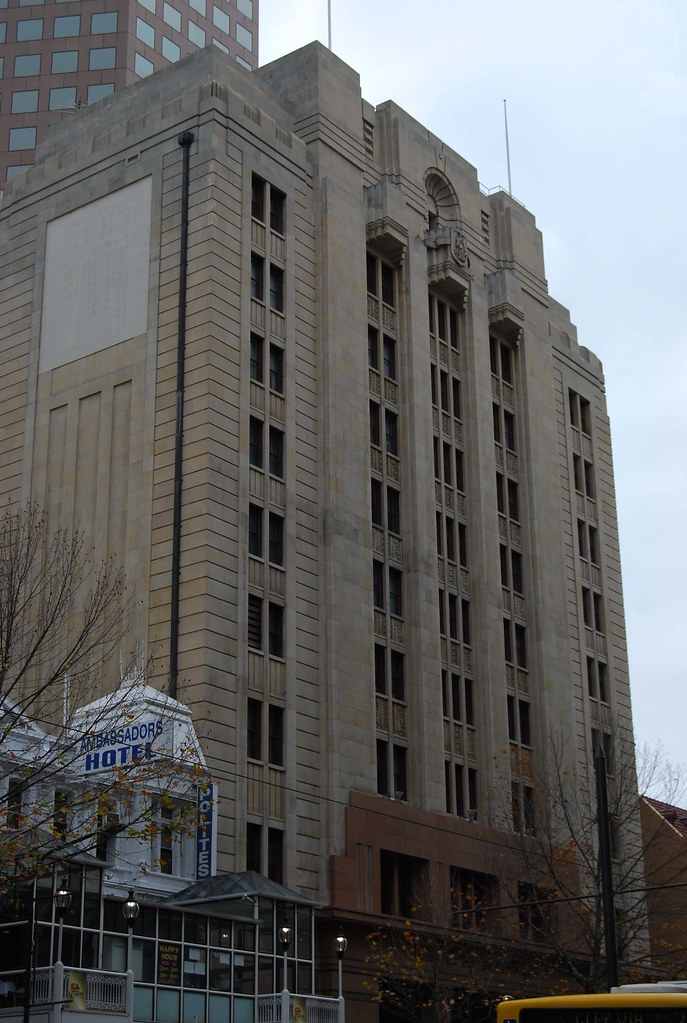
This morning I took part in a walking tour of art deco architectural highlights of Adelaide CBD hosted by the Art Deco Society - Adelaide Chapter.

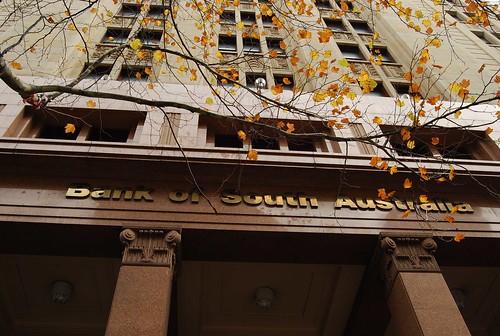
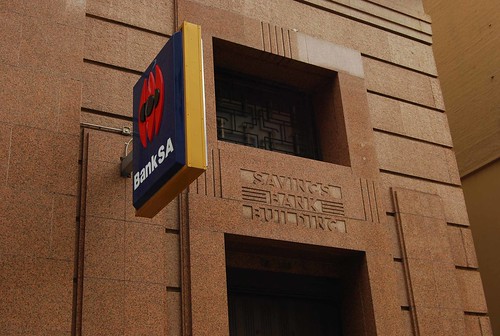
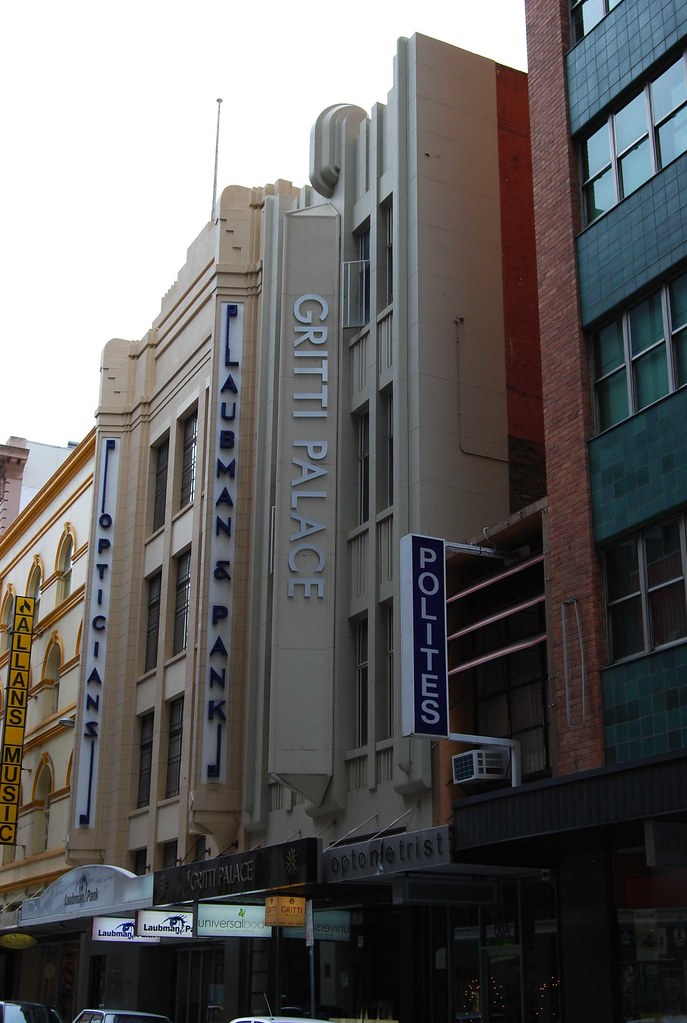
The tour revealed a number of architectural gems tucked away in the city's side streets. Notable and my favourites are the Laubman and Pank Optometrists and Gritti Palace, Bank of South Australia, Fletcher Jones Building and the Gilbert Place Apartments.

Architectural examples of this early 20th century international movement have
always held some fascination along with the Bauhaus style, Arts and Crafts Movement and Art Nouveau.

In the Philippines, particularly Manila, Art Deco is associated with American colonial architecture. This architectural style flourished when the country was an American colony. Buildings that I fondly remember include the Metropolitan Theatre and Far Eastern University. However, a number of the buildings were destroyed in the Second World War or have been demolished.

In Adelaide, impressive examples that remain almost in their original designs include cinemas, residences and commercial buildings.

Bank of South Australia, King William Street

Bank of South Australia

Labels: , , , ,

Monday, May 26, 2008

Adelaide City Bridge

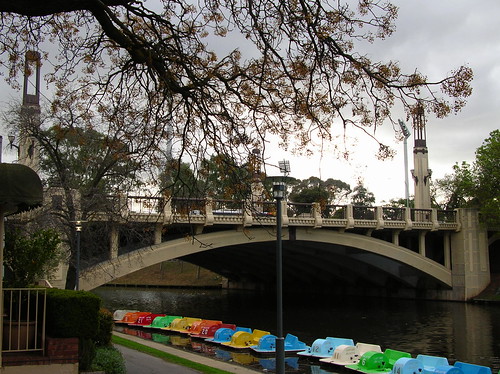
The photograph featured today in the weather segment of the ABC 7:00pm News (Adelaide) was this photo of the Adelaide City Bridge.

Adelaide Bridge

Bridges have always held a certain fascination for me. For the most part regarded as engineering feats, these structures are likewise architectural design marvels. Taking the course in Architectural Science as part of my undergraduate degree, I became more fascinated in the engineering design of bridges.

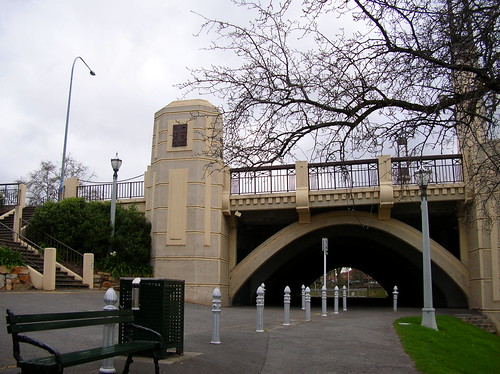
The Adelaide City Bridge, also known as the King William Street Bridge in Adelaide, South Australia is one of ten bridges that span the River Torrens. The first bridge was one of timber built in 1839 approximately 500 metres west of the current City bridge, but destroyed by floods in September 1844. In 1849, £6000 was allocated to bridge the Torrens. Within four years three wooden bridges had been built and subsequently destroyed in floods.

In June 1856 the English-manufactured, iron City Bridge was opened, extending King William Street to North Adelaide. A photograph of the City Bridge, circa 1866 shows a bowstring type suspension bridge design with trussed arches. Another Townsend Duryea photograph circa 1866 shows the road over the City Bridge. The iron bridge was widened in 1877 then converted into a two-lane bridge in 1884.

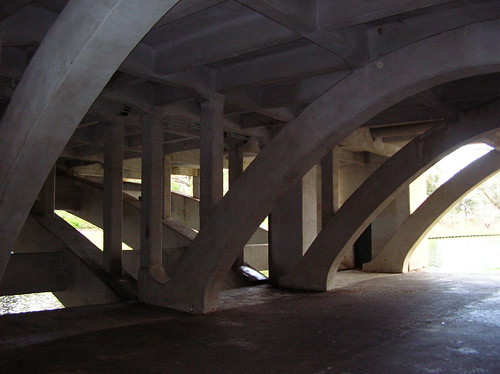
In 1931, the bridge was replaced with a concrete open spandrel deck arch structure. The present day concrete bridge features art deco architectural details reminiscent of the popular movement of the 1930s.

Adelaide Bridge

Adelaide Bridge

See also: Bridge Basics for a general description of most bridge types.

Labels: , , , , , ,

Sunday, April 27, 2008

Colour me [autumn] happy

Mt Lofty Botanic Gardens

After that wonderful autumn weather in the last two weeks, this long weekend has marked the record books. Yet again another weather phenomenon for Adelaide. According to Weatherzone, today's bitterly cold winds, cloud and showers have made this the coldest April day in 26 years for Adelaide and the coldest on record for several inland towns. The rains were also the most widespread and heaviest in more than five months. The highest rainfall since December, it should be good and timely for the sowing of winter crops.

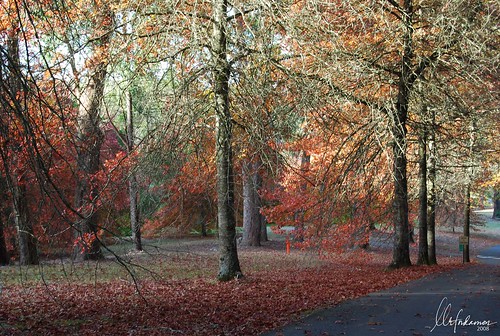
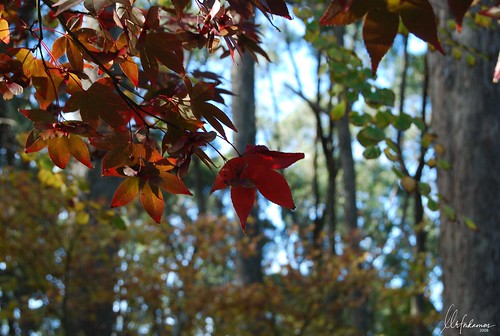
However, last weekend was just perfect weather for taking pictures and honing some skills in landscape photography. With a couple of friends, we headed off to Mount Lofty Botanic Gardens and tried to capture some autumn images. The autumn colours of the Adelaide Hills were just wonderful.

Mt Lofty Botanic Gardens

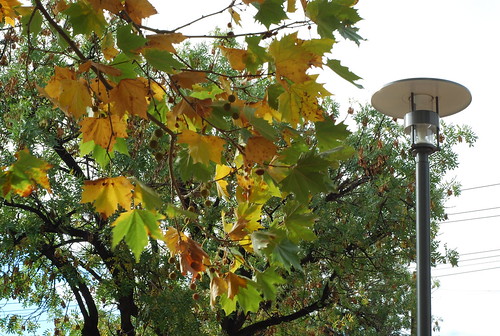
Autumn leaves

Labels: , , , , , ,

Sunday, April 06, 2008

ABC Weather Photo

Adelaide Skyline

This photo of the Adelaide Skyline as viewed from Wellington Square in North Adelaide was today's weather photo in ABC 7:00pm News.

Today was also the O'Connell Street Food and Wine Affair annually held at the Wellington Square, where cafes and restaurant of O'Connell Street Precinct provide outstanding cuisine at low prices.

Labels: , , , , ,

Sunday, March 16, 2008

Autumnal Equinox

It certainly was a very hot start to Autumn in South Australia. Today, Adelaide
still continues to swelter with a maximum temperature of 39.9°C, smashing the previous capital city record of 10 days straight above 35°C set by Perth in February 1988. The weather bureau predicts another hot day tomorrow at 39°C which will make it Adelaide's 15th consecutive day above 35°C, the longest such run since records began over 120 years ago, and also the longest on record for any Australian capital city.

Hot start to autumn

Hopefully the heatwave would break as predicted on Tuesday when a cool change, with a maximum temperature of 30°C, is likely to move through Adelaide. Weather forecast indicates a second surge of cold air will sweep across southeastern Australia on Thursday with the cooler southerly winds set to filter through, dropping daytime temperatures below average.

Thursday, 20 March also happens to be the autumnal equinox (05.48 UTC).

Change of season (or burnt?)

Labels: , , , ,

Monday, March 10, 2008

In vino veritas


With no end in sight to the extreme and searing temperatures Adelaide is currently experiencing, an outing to one of Australia's best-known wine regions was the deed for the day. So, with temperatures soaring to 40°C yesterday, with some friends, we visited a couple of cellar doors in the Barossa Valley.

The Barossa is only about 70kms north of Adelaide and the valley is well known for its Shiraz. Australia's oldest Shiraz vines still live on in the Barossa from low yielding dry grown bush vines that produce highly concentrated, lush, complex, rich, intense, and full-bodied wines. Albeit that 'Lonely Planet' spill, I certainly am not a wine connoisseur. On occasions that I have to get wine to give as a gift or to serve with food, I usually let the shopkeeper at the nearest bottleshop be my sherpa. But having stayed at a residential college run by Jesuit priests who also established Sevenhill, one of the oldest existing wineries in Clare Valley, being served wine during high table dinners was a regular occasion that I have acquired a particular liking for a certain wine variety.

Though surrounded with friends who love the red wine varieties and extol their virtues, my palate has yet to mature to develop the appreciation for reds. I am partial to whites - Riesling and Pinot Grigio, particularly the sweet ones. My favourites are Gewürztraminer (Sevenhill, Clare Valley), Select Late Harvest Riesling (Bethany Wines, Barossa Valley) and Wrattonbully Botrytis Viognier (Yalumba, Barossa Valley).

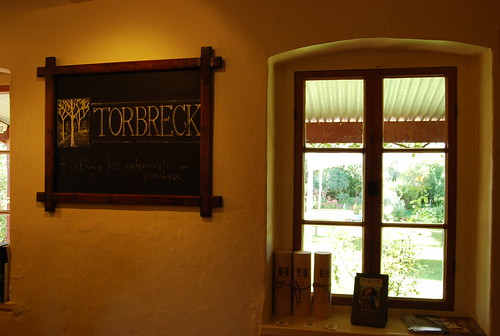
After the tasting, I picked up a couple of whites which I think I will enjoy: Torbreck's 2007Woodcutter's Semillon and Rockford's 2007 White Frontignac. Giving in to caprice, I also got a bottle of red: Torbreck's 2005 The Steading (which is a blend of the three of the traditional Barossa Valley grape varieties: Grenache, Mataro or Mourvedre and Shiraz).

Torbreck Barossa Valley

How to do wine tasting without sounding like a dolt (as seen at BNET):
Pour out a little into each glass — they shouldn’t be any more than one-third full, otherwise you could spill the wine when you swirl. Note your impressions of each of the following:

Look. Hold your glass up to the light. What color is the wine? Is it light red, deep purple, or somewhere in the middle? Is there some brown mixed in? Now swirl the wine a bit in the glass. Does it leave thick or thin streaks on the inside of the glass? Those streaks are the oft-described “legs”; thicker legs mean the wine has more alcohol.

Smell. Tilt the glass, stick your nose in it as far as you can without getting wet, and take a deep breath. What does the wine smell like? Aromas that typically occur in wines include:
Fruit
Herbs
Veggies and grass
Fresh dirt (actually a good smell)
Flowers
Tobacco
Smoke
Chocolate

Taste. Take a sip of the wine and swirl it around in your mouth a bit (don’t overdo it — you’re not gargling with Scope). What does it taste like? You’ll notice that many of the aromas that you found while sniffing the wine are repeated as flavors when you taste it. But you’ll also discover these basic qualities:
Sweetness versus dryness. In the beverage world, “dry” means a lack of sweetness. Dry beverages include mineral water and vodka; a sweet beverage would be Pepsi-Cola. Don’t confuse sweetness with “fruitiness.”
Fruitiness. Your wine may have hints of various fruits, such as citrus fruits, melons, pears, apples, cherries, berries, and/or jelly or jam.
Acidity. Does the wine make your mouth pucker? If so, its acidity is probably high, which helps the wine pair better with foods.
Tannin. Gives a “raspy” feel in your mouth, like you get after drinking cranberry juice. Tannic wines often pair well with heavy foods such as beef.
Body. Does the wine feel heavy, medium heavy, or light in your mouth?
Finish. A wine will taste differently after swallowing than it did when it first hit your tongue. How long these flavors linger will help you tell whether the wine’s finish, or aftertaste, is short, medium, or long.

Do this ritual (look, smell, taste) when you start on your first bottle of wine or when you move from one bottle to another — not every time you take a sip.

Read more: Tasting Wine, Australian White Wines, Australian Red Wines.

Labels: , , , , ,

Sunday, March 09, 2008

Change of climate or natural climate variability

Barring the temperatures South Australia is currently experiencing, autumn has always been my favourite season. I especially like the myriad of autumn colours -the golden browns, yellows, reds and oranges.

Signs of Autumn

Leaves are FALL-ing yet temperatures are soaring. For over a week now, Adelaide is roasting in the midst of a long heatwave. It has been a hot, blistering start to autumn.

Based on the heat wave definition of five consecutive days with a top temperature over 35°C, Adelaide is in the grip of its first autumn heatwave in almost 70 years. Today, after four consecutive days of over 37°C, the temperature reached 40°C which was 14K above average and it was the hottest March day in four years. Weather forecast indicates that the trend of mid-30s temperatures is set to continue until the end of next week. Records then show that it will be the first time in 68 years Adelaide has reached 37°C on six consecutive March days. Phew!!

Labels: , , , ,

Monday, February 11, 2008

Adelaide "Green" Connector

One of the Adelaide City Council's (ACC) initiative is to provide a free bus service, the Adelaide Connector, which links North Adelaide and the CBD. To my knowledge this bus service has been in operation since 2001. It really is a convenient service as its routes (the Red route and Green route) include streets not plied by the regular public buses. Plus, it's free! The Red route (nicknamed the Red bus) starts at 8.00am in North Adelaide and heads towards the City. Whereas, the Green route or the Green bus would commence the service from the city to North Adelaide. I would use the service every morning to go to work and I take the Red bus.

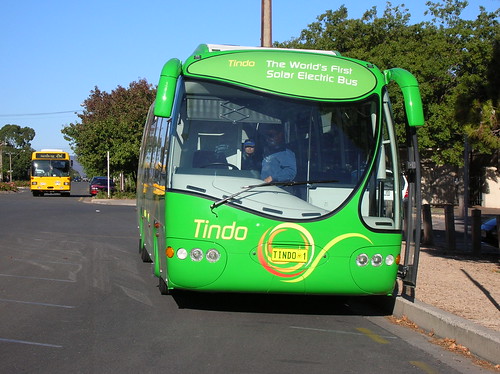
This morning, the Red bus has turned "green". Today was the inaugural service of the world's first solar electric bus. Launched in December 2007, the green "Tindo" (Kaurna Aboriginal word for 'sun') bus with plates "Tindo 1" now plies the Red route of the Adelaide Connector. Hooray for the ACC! I took part in history by being one of the first to use the world's first solar electric bus. Being a fully electric vehicle, the bright green bus with quirky exterior design is very quiet. Read more about Tindo here.

"Green" Adelaide Connector

In thinking of going 'green', one wonders if factors of embodied energy and embodied water in product manufacturing are taken as criteria for sustainability. More often than not, in aiming for being green or sustainable, we have become more end-product oriented. The process to get to that end-result, which is crucial in the holistic assessment if indeed the product is deemed a 'green initiative' is often relegated to the side. Among the questions perhaps that needs to be asked is whether in the production of Tindo, green measures have likewise been considered.

Labels: , , ,

Sunday, January 27, 2008

Reduce, Reuse, Recyle

In line with the global move to mitigate humankind's impact on the environment, lifestyle changes are encouraged. An example is Australia's Department of the Environment, Water, Heritage and the Arts' promotion of the principles of the "5Rs": Rethink, Reduce, Reuse, Repair and Recycle.

Rethink - the use of all resources. Is there a more environmentally friendly way of doing things, or do you really need to do it? Each time you purchase you create a demand. Think before you buy! For example, walk, join a car pool or catch a bus instead of taking the car, take a shopping bag instead of using plastic bags.

Reduce - the use of all resources, especially non-renewable ones. If you must do it use the alternatives that technology makes available. For example, send and read information electronically instead of printing it on paper, use renewable energy sources such as solar power.

Reuse - where possible reuse resources. For example, use newspaper for garden mulch and milk cartons for tree guards.

Repair - rather than throwing things away
For example, try to buy repairable equipment, sell/give broken whitegoods to repairers rather than sending it to landfills.

Recycle - waste items wherever possible. For example, sort your garbage and recycle all cans, bottles, paper and glass, set up a compost heap for food scraps.


Certainly in keeping with the city's reputation as one of most livable destinations in the world (ranking 6th, 2006), is the access of residents to services and infrastructure. Among the services Adelaide City Council provides is the Hard Refuse collection for domestic premises. Four times a year, the pedestrian paths in residential neighbourhoods will have an orderly pile of discarded household items for council's collection. These could range from furniture, bathroom fittings, to old white goods.

In the last council collection, this was a pile I saw from a house a number of blocks from the apartment building:


The Guggenheim Collection 1991 promotional poster of the Art Gallery of New South Wales now hangs on my hallway wall.


Oh well ... someone's trash is somebody's treasure.

Labels: , , , , ,

Sunday, December 30, 2007

Sizzling New Year


Just one hour left before sundown and it is still a sweltering 39 degC (with 12%RH). Today, Adelaide had a maximum temperature of 41.5 degC! New Year's Eve is promising to be sizzling - 41 degC! I'm keeping my fingers crossed for that cool change on New Year's Day - a forecast of 35 degC.

As seen at ScienceWoman:


Happy New Year!

Labels: , , , ,

Friday, December 28, 2007

Christmas-New Year Weather


The Australian Christmas season is not White. Almost always the weather DownUnder during Christmas is with blue skies and recently the temperatures on the mainland ranges from 30-40 deg C. However, seasonal variations of summer have also been experienced - floods, electrical storms, hailstorms and bushfires. My first Christmas here in 2001 was perhaps one with the most variations on record - floods in northern Australia, dozens of bushfires in southeast Australia and I experienced my first hailstorm in Melbourne on Christmas Day! I also remember that summer to be cool-cold in Adelaide. I went to the New Year's Eve celebration at Victoria Square wearing a jacket.

I've spent the last four Christmases in Australia and the weather has certainly been unpredictable. Last year's Christmas was spent in Wagga Wagga, NSW and I remember both Christmas and Boxing Days as windy and cold.

However, in my experience, the eve of the New Year is always sweltering. In 2005, my mother was unfortunate to experience the dry and scourging heat firsthard - 40-42degC temperatures! I tell you - she complained incessantly (I don't have air conditioning in my flat).


Today, Adelaide's maximum temperature was close to 38 degC and 6% RH. The temperature outlook for New Year's is a dry, 41 degC ... phew!


Checking the weather forecast for the Philippines, it is a lot cooler - 31deg C. How's the New Year's Eve weather looking where you are?

Labels: , , , ,

Sunday, December 23, 2007

Have a Merry Christmas!

I just remembered this line from an episode of The West Wing which I think is fitting this festive season:

"FAITH is [t]he substance of things hoped for and the evidence of things not seen." (Hebrews 11:1)

Merry Christmas everybody and good wishes for the coming New Year!


*Adelaide Arcade, Rundle Mall

Labels: , , ,